


Introduction (AI Engineer Roadmap)
Becoming an AI Engineer is no longer just a dream it’s a skill in high demand. Whether you’re starting from scratch or transitioning from another field, this roadmap will guide you step by step to build the skills, complete projects, and become job-ready in AI.
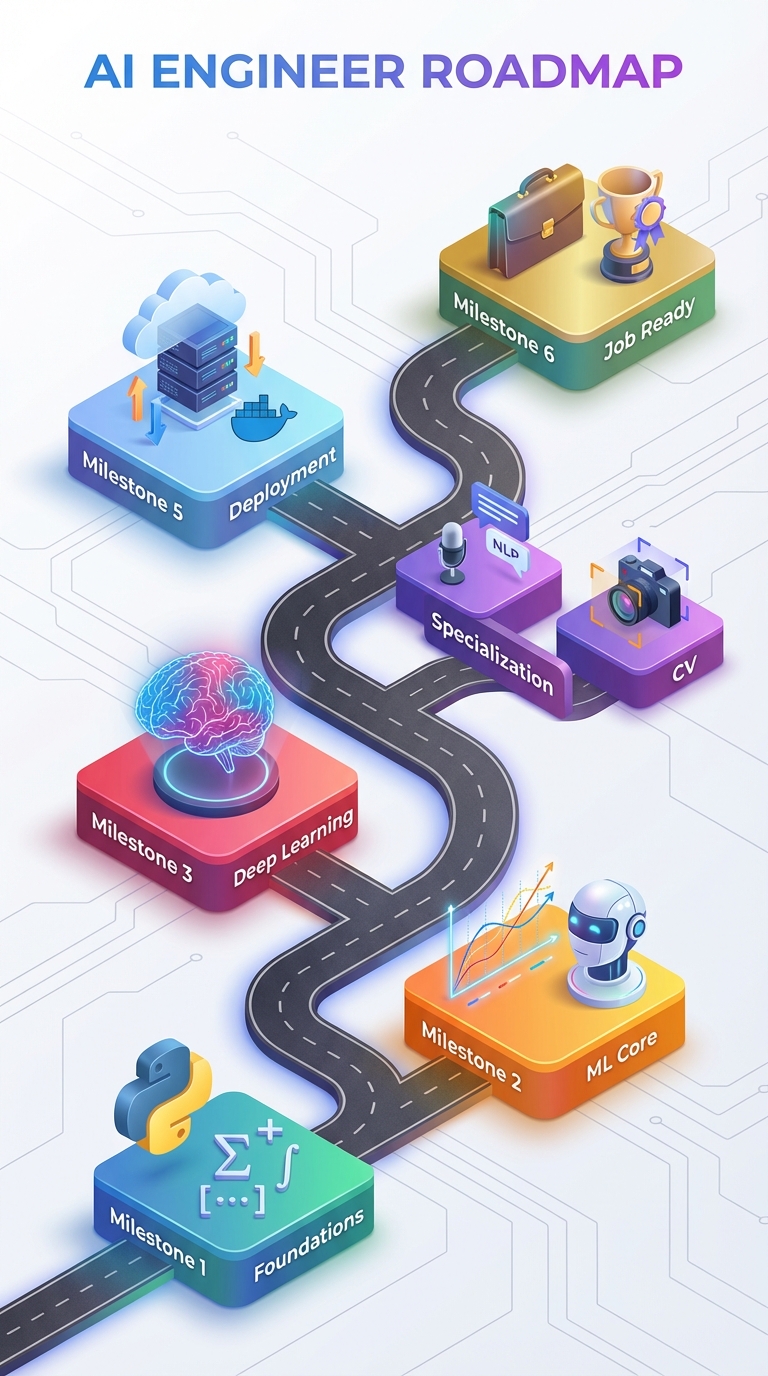
Phase 1: Foundations (4–6 weeks)
Goal: Strong programming and math basics
Skills to Learn:
- Python: variables, loops, functions, OOP basics
- Libraries: NumPy, Pandas, Matplotlib, Seaborn
- Math:
- Linear Algebra: vectors, matrices, dot product
- Probability & Statistics: mean, variance, distributions, Bayes theorem
- Tools: Jupyter Notebook, Git & GitHub
Projects/Practice:
- Python mini projects: calculator, data analysis on small datasets
- Visualize datasets using Matplotlib/Seaborn
Phase 2: Machine Learning Core (6–8 weeks)
Goal: Understand ML concepts & implement algorithms
Skills to Learn:
- ML Concepts: Supervised & Unsupervised learning, train/test split, cross-validation
- Algorithms:
- Regression: Linear, Logistic
- Decision Trees & Random Forest
- K-Nearest Neighbors
- Clustering: K-Means
- Libraries: scikit-learn, Pandas, Matplotlib
Projects/Practice:
- Predict house prices (Regression)
- Customer segmentation (Clustering)
- Titanic survival prediction (Classification)
Phase 3: Deep Learning (6–8 weeks)
Goal: Learn neural networks & advanced ML
Skills to Learn:
- Neural Networks basics (ANN)
- Backpropagation, activation functions
- CNN (Computer Vision) basics
- RNN / LSTM (Sequential data, NLP basics)
- Framework: TensorFlow or PyTorch (choose one)
Projects:
- Image classifier (CNN)
- Text sentiment analysis (RNN/LSTM)
- Digit recognizer (MNIST dataset)
Phase 4: AI Specialization (6–8 weeks)
Goal: Specialize in one AI field
Choose one track:
1) NLP / Generative AI
- Transformers (BERT, GPT)
- HuggingFace library
- Fine-tuning LLMs
- Prompt Engineering
2) Computer Vision
- Object detection (YOLO, OpenCV)
- Image segmentation (U-Net)
Projects:
- Chatbot (NLP)
- Image detection project (CV)
Phase 5: Deployment & Engineer Skills (4 weeks)
Goal: Be a full AI Engineer, deploy real models
Skills to Learn:
- Flask / FastAPI for deploying models
- Docker basics
- Cloud basics (AWS/GCP/Azure)
- ML pipelines (for production-ready models)
Projects:
- Deploy your NLP/CV model on a web app
- Make it interactive with REST API
Phase 6: Portfolio & Job Readiness (2–3 weeks)
Goal: Showcase skills & get AI Engineer role
Action Items:
- GitHub: clean repos + project documentation
- Resume: projects first, skills highlighted
- Kaggle competitions: 2–3 small ones
- Interview prep: Python & ML basics
Daily Routine Example
- 2 hrs: Learning theory
- 1–2 hrs: Coding / implementing
- 30 min: Revision / notes
